

What We Learned from Series 2 of Work Truths: Off the Record

Series 2 of Work Truths: Off the Record, which has recently been completed, took a single, quietly pervasive workplace experience — the imposter phenomenon — and turned it inside out over eleven episodes.
Host Rachel Morris spoke with psychologists, HR leaders, therapists, engineers, and her own coaching colleagues, and the result is one of the most layered explorations of self-doubt at work you'll find in a podcast feed. Here's what stood out, and what you can actually do with it.
It's a phenomenon, not a syndrome
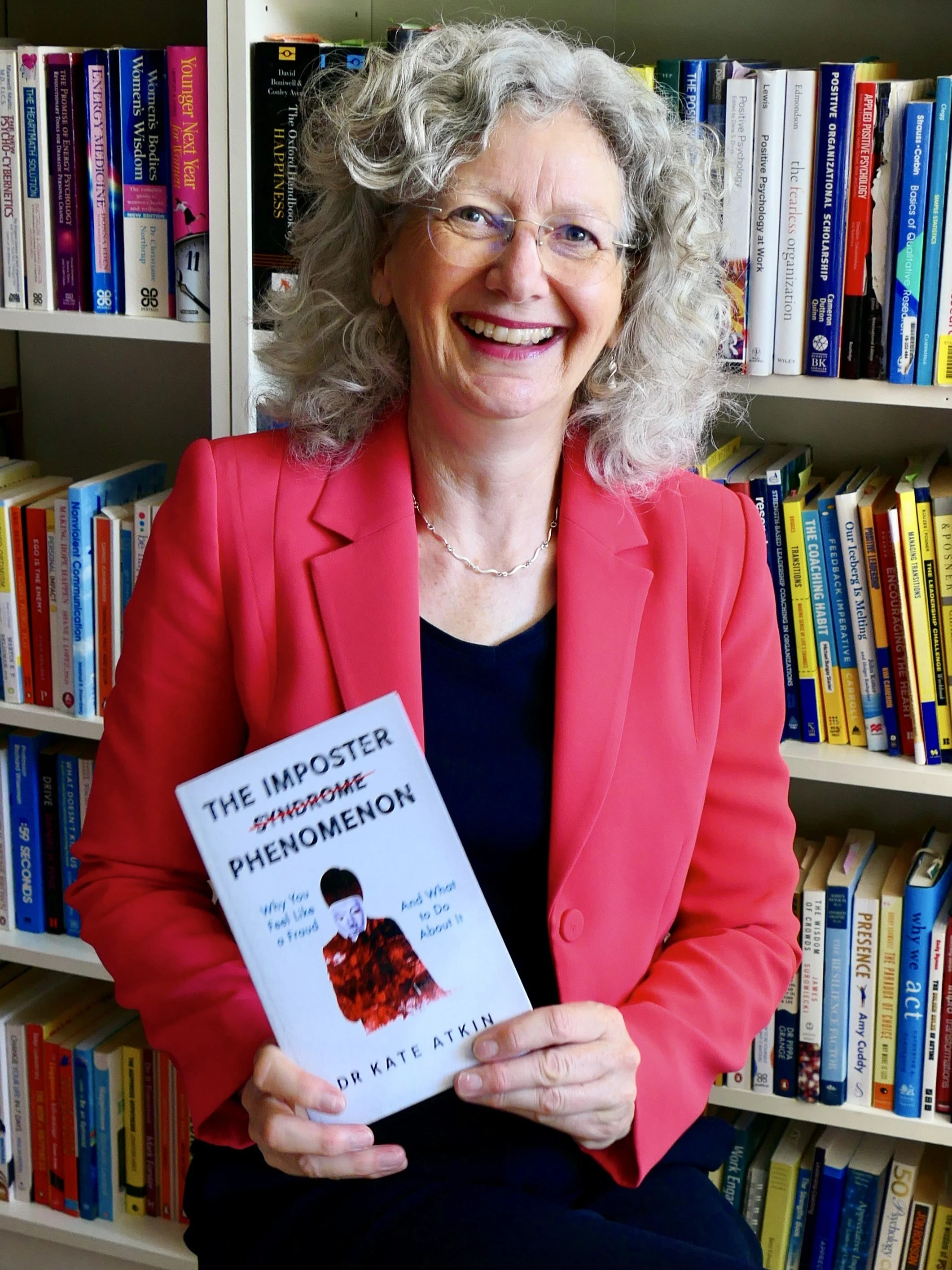
Dr Kate Atkin
The single biggest reframe running through the series is linguistic, and it matters more than it first sounds. This isn't one researcher's pet theory — it's a position shared across the field. Dr Kate Atkin, whose research and book underpin much of episode 2, argues that the word "syndrome" pathologises something that is, in fact, a normal and situational experience rather than a mental health condition. Dr Terri Simpkin, another leading voice in this space, makes the same case in her own words: "it's not a syndrome, it's a phenomenon that's situational". The two have gone further than simply agreeing in interviews — they jointly launched International Imposter Phenomenon Awareness Day specifically to shift language away from "syndrome". Research they've each contributed to suggests around 70% of people experience these feelings at least once in their working lives.

Dr Terry Simpkin
That distinction isn't just semantics for a podcast title. If imposter feelings are a syndrome, they feel fixed, something wrong with you. If they're a phenomenon, they're situational, triggered by specific conditions, and therefore something you can learn to navigate.
It shows up differently depending on who you are
One of the strengths of Series 2 is its refusal to treat imposter feelings as a single, uniform experience. Guests included Denise McMurray, Chief People Officer at the RSPB, bringing an HR and organisational lens to episode 3, and Charlotte Allocca, an integrative psychotherapist, offering a therapeutic perspective in episode 4, exploring how childhood labels, family narratives, and experiences of not quite "fitting in" shape the inner voice people carry into adult life. Atkin's research adds that men and women often cope differently — women may hold back, women may push through — but both routes can lead to stress and eventual burnout. Simpkin's work complements this by looking at how workplace structures themselves, from talent management to reward systems, can implicitly keep imposter feelings alive rather than treating the issue as purely individual.

Dr Lucy Ryan
Episode 8, with Dr Lucy Ryan, coach and author of Revolting Women, brought a midlife lens to the conversation, exploring why imposter feelings can resurface at exactly the point of growth and how gendered ageism plays a role. Episode 7, with Erik Johnson, an instrument operations group leader at the ISIS Neutron and Muon Source, added a technical and engineering voice, showing imposter feelings aren't confined to "soft" professions or client-facing roles, and that they can show up in the body as much as the mind.
The environment matters as much as the individual
A recurring thread across the series is that imposter feelings aren't purely internal — they're shaped by context. Both Atkin and Simpkin's work points to this: Atkin highlights how a lack of representation, being "the only one like you in the room," intensifies self-doubt, while supportive managers and inclusive environments can significantly reduce it. Simpkin's research pushes further into organisational design, arguing these feelings often stem from environments where expectations are opaque, standards keep shifting, and belonging feels conditional, rather than a personal flaw to be fixed with affirmations. This lands squarely in coaching and HR territory: it's not enough to tell someone to "believe in themselves" if the system around them keeps signalling that they don't belong.
Overworking is a coping mechanism, not a personality trait

Charlotte Allocca MBACP
Several guests touched on overpreparing, over-qualifying, and perfectionism as maladaptive responses to imposter feelings rather than simple diligence. Simpkin identifies a specific cycle linking procrastination, perfectionism, overwork, self-doubt, and the exhausting crash that often follows success, while Atkin distinguishes between adaptive preparation and maladaptive over-preparation that serves anxiety rather than the task at hand. Recognising the difference is one of the more practically useful distinctions in the whole series, especially for high-achieving professionals who wear "I just work hard" as a badge of honour.
What the coaches said when they looked back
The final episode of the series took a different format entirely. Rather than a new guest, Rachel sat down with two of her own colleagues from the Motion Learning coaching team, Rakhee Patel and Helen Brooks, both leadership coaches, to reflect on everything the series had surfaced. This closing conversation is arguably one of the most useful for readers wanting practical takeaways, because it's where the individual guest stories get translated into what coaches actually do with clients experiencing imposter feelings, rather than staying at the level of theory or personal anecdote. Hearing the series distilled through a coaching lens, after ten episodes of varied expert and lived-experience perspectives, gives a sense of the recurring patterns coaches see across very different clients and industries.
Practical actions for readers
We've pulled a few of the learning points from the series together:
Notice when your name or background becomes part of the story you tell yourself.
Episode 9 with Tarquin Bennett-Coles explores how something as personal as your name can quietly trigger imposter thoughts, with a recommendation to pay attention to identity-based triggers rather than assuming self-doubt is only about competence.
Talk about it, especially if you're a leader.
Erik Johnson, who shares his story in episode 7, is the clearest example of this in action: a senior technical leader speaking openly about self-doubt showing up in the body as well as the mind.
Distinguish preparation from over-preparation.
In episode 4, Charlotte Allocca, an integrative psychotherapist, unpacks the perfectionism and anxiety that can drive people to over-prepare well beyond what a situation actually requires.
Reframe your language.
The shared work of Dr Kate Atkin and Dr Terri Simpkin is the direct source for this: moving from "imposter syndrome" to "imposter phenomenon" reflects the idea that this is a normal, situational experience rather than a fixed condition.
Watch for the internal "bully" voice that shows up just as you're succeeding.
Dan Cardwell, a marketeer and comedian, looks at this pattern directly in episode 10, showing that self-criticism can intensify at the exact moments confidence should be building.
Look at your team's environment, not just individuals.
Episode 5 brings a legal and organisational perspective into the series, as Emma Clark explains how workplace structures and cultures can heighten or reduce imposter feelings, independent of any one person's mindset. This echoes Simpkin's wider point that talent management and reward systems can quietly sustain imposter feelings across a whole organisation.
Start collecting specific praise.
In episode 3, Denise McMurray, Chief People Officer at the RSPB, explores confidence through the lens of a career and role transition, where specific, meaningful feedback matters more than generic reassurance. Erik Johnson echoes this in episode 7, describing his own practice of keeping a record of thanks and specific feedback to notice his value bit by bit.
Ask what a coach would actually do with this.
The finale with Rakhee Patel and Helen Brooks is the natural place to start if you want the series' insights translated into practical coaching approaches rather than theory.
Why this series matters beyond the podcast feed
The topic has genuinely wider momentum right now. BBC Radio 4's The Bottom Line recently ran its own episode on the Imposter Phenomenon, and Rachel Morris noted the overlap, pointing listeners back to the full Series 2 catalogue as a deeper resource. For a workplace-mental-health podcast, that kind of alignment with mainstream media is a strong signal that the conversation has reached critical mass. The fact that researchers like Simpkin and Atkin have gone as far as launching an awareness day together shows how far this conversation has travelled beyond a niche academic concern.
What Series 2 ultimately offers isn't a single answer but a set of angles — psychological, organisational, therapeutic, personal, and now practical — on an experience almost everyone has had but few talk about honestly. If you only have time for a few episodes, start with episode 2 for the reframe, episode 7 for the human depth, and the finale for how it all comes together in practice.
References and sources of further information
The Imposter Phenomenon by Dr Kate Atkin
The research and public work of Dr Terri Simpkin, including her Braver Stronger Smarter programme.
Revolting Women by Dr Lucy Ryan